About
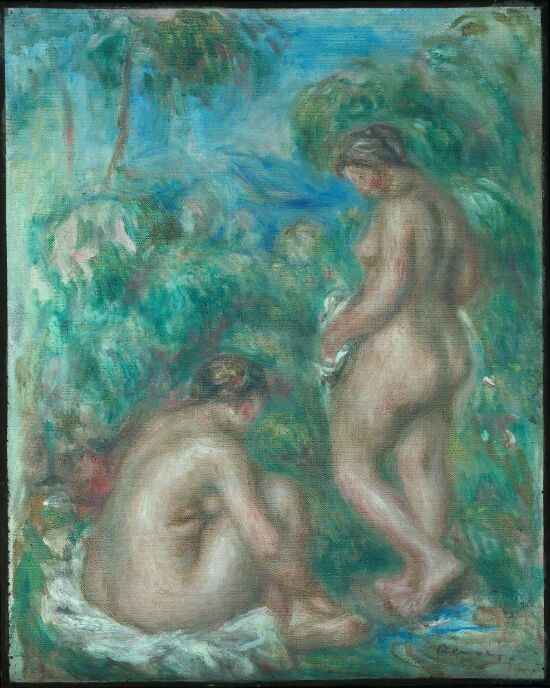
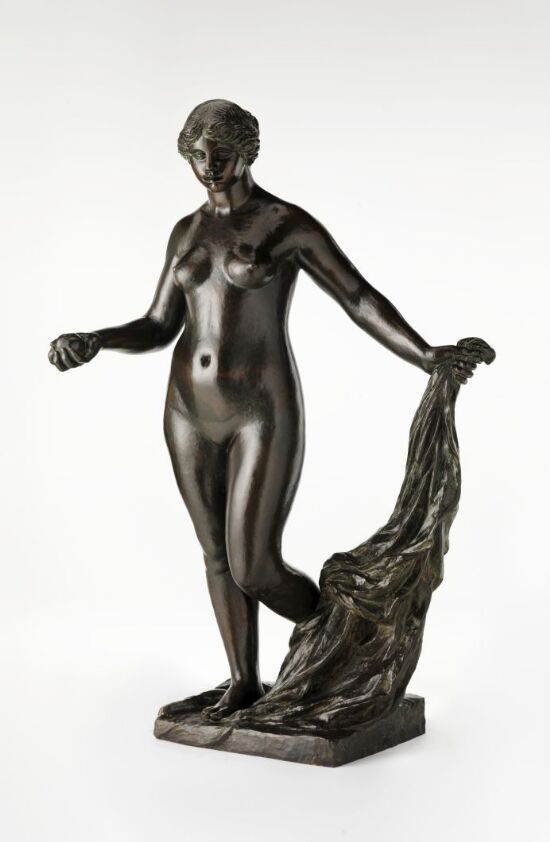
During the 1880s Auguste Renoir began exploring a type of painting that his contemporaries showed little interest in: classical nudes. With their naturalistic bent, most impressionists considered this genre to be an outmoded, academic exercise, but Renoir chose to appropriate the great classical heritage, from Raphael via Rubens to Ingres, in an attempt to cultivate a style of painting liberated from impressionist happenstance. He sought the beauty of lines and shapes within a harmonious, sensual whole, such as it could be expressed corporeally in young women.
After the bath epitomizes this new direction in Renoir’s art. Some considered this turn toward the classical ideals as treacly kitsch, while others, such as Matisse and Picasso (in the 1920s), found inspiration for their own work in the “late” Renoir. In the painting, a young woman has risen like a latter-day Aphrodite from the blue-green sea of the background, and as depicted within a simple, classical triangular composition, she sits and dries her still wet body.
The picture came to Scandinavia in 1914, first for an exhibition in Copenhagen and then for the National Gallery’s “French Exhibition” in the summer of 1914. Because of the outbreak of the First World War, the painting remained in the museum, although it still belonged to a French art dealer. Thanks to generous funding from the Norwegian shipowner Tryggve Sagen, After the Bath became a permanent part of the National Gallery’s collection in 1917.
- Creation date:
- (1883)
- Other titles:
- Petite baigneuse (FRE)
- Object type:
- Painting
- Materials and techniques:
- Olje på lerret
- Material:
- Canvas
- Dimensions:
- Height: 60 cm
- Width: 54 cm
- Keywords:
- Visual art
- Classification:
- 532 - Bildende kunst
- Motif - type:
- Nude
- Inventory no.:
- NG.M.01166
- Cataloguing level:
- Single object
- Acquisition:
- Gave fra skipsreder Tryggve Sagen 1917
- Owner and collection:
- Nasjonalmuseet for kunst, arkitektur og design, The Fine Art Collections
- Photo:
- Børre Høstland/Jarre, Anne Hansteen
Nasjonalmuseet's collection catalogue is a living resource of information gathered since the 1830's. Some records may contain language or ideas that today could be perceived as outdated, offensive or discriminatory with regard to for instance gender, sexuality, ethnicity or disability, and that may be at odds with the museum's values regarding equality and diversity.
Do you have suggestions for how this record can be improved? We would like to hear from you!
If you would like more information about specific objects in the collection or about objects that haven't been published online, please contact the museum. You can read more about how we work with the collection and our cataloguing practice here.