The Day After
- Artist: Edvard Munch
- Creation date: (1894)
About
- Edvard Munch bestandskatalog
Lying on the bed is a woman with an open blouse, her hair hanging loose and her eyes closed. The title of the picture and the empty bottles on the table indicate something has happened. Might she be sleeping off a hangover? Munch painted three versions of The Day After. The one in the National Museum was the last of the three and the only one we know of that still survives. The first version, dated to the period 1886--89, was destroyed in a fire at Christiania Forgyldermagazin in 1890 (Woll M 142). The second was probably painted shortly afterwards, but is now also lost (Woll M 258). It is documented in a photograph taken during Munch's exhibition at the Equitable-Palast, Berlin, in 1892 or 1893. In addition to the painting from 1894, there is a pen-and-wash drawing from some point in the period 1892--94 (MM.T.02348) and a print version from 1894 (Woll G 10).
A photograph dated 1894 shows the painting standing unfinished on the floor of Munch's studio in Berlin (Eggum 1983, 114). The glasses and bottles that stand in the foreground in the latest version are absent. On 1 May 1894, Morgenbladetprinted an account of a visit to Munch's Berlin studio, which mentions some of his more recent paintings. This article, together with the aforementioned photograph, corroborate the dating of the painting:
'Puberty' and 'The Morning After' are the titles of two studies, two large pictures. The former shows a young, skilfully painted naked female figure, the latter a half-dressed woman who has thrown herself down on her modest bed, beside which stands a wooden chair with a glass and an empty wine bottle. The subject is not exactly appealing, but the drawing is well done and without the bizarre, outlandish colours. It really does seem as if, in the works currently in progress, Munch has taken a step back from his earlier aberrant penchant for harsh, peculiar colour effects and baffling subjects.
Madonna (Nasjonalmuseet, NG.M.00841), The Day After and Puberty (Nasjonalmuseet, NG.M.00807) were all painted in 1894. It would appear that Munch used the same model for the first two. All three works are central to Munch's conceptualisation of the woman, and in the scholarly lite- rature they are often discussed as a group. Late in life, Munch reflected on the significance of the female gender during his own life time: "Kierkegaard lived in the time of Faust -- Don Juan -- Mozart -- Don Juan. It was the man who seduces the innocent girl. I have lived in the period of transition in the midst of women's emancipation. Here it is the woman who seduces and lures and deceives the man
-- the time of Carmen" (22 February 1929, MM.T.2744). Many of Munch's pictures and texts demonstrate a lively awareness and deep fascination for this defining topic, which was one of the most widely debated of the era. Depictions of women figure prominently in his work. They deal with different themes and perceptions of women and are collectively open to a variety of conflicting interpretations. Although Munch's personal relationships with women were ambivalent, his atti- tudes to women in general seem modern (Owesen 2013).
The Bohemian circle in which Munch moved favoured gender equality, and his views on women were shaped by his connections with this community of intellec- tuals and artists. In his book on Munch, Jens Thiis discusses The Day After under the heading "Munch and the Bohemians". He writes that some are likely to view the work as a "social" painting that reflects the lifestyle of this group, a view Thiis himself disputes (Thiis 1933). In terms of theme and execution, the picture does, however, have some features in common with the realism of the 1880s. Although it was painted in 1894, The Day After differs significantly from Munch's typically symbolist paintings of the 1890s. It was a controversial work in its day. The fact that the first version was painted in 1886 puts it in an interesting relation to Chris- tian Krohg's works on the Albertine theme, which tackle the problem of socially vulnerable women. When The Day After appeared in a large Munch exhibition in Prague in 1905, the Czech writer Milos Martens also alluded to the realist context:
And Munch painted these people ... scenes of Bohemian life and the demi-monde. 'The Day After' is his seminal work from this period ... The semi-naked body on the bed has stiffened in a posture of exhaustion and despair; the scene is permeated by the mundane aftertaste that indul- gence leaves on the lips, for indulgence is what this is all about ... Degas would surely praise the picture's trenchant realism, its forthright idiom ... (Torjusen 1971 A, 62)
The Day After was one of five paintings the National Gallery acquired from a Munch exhibition at Blomqvist in 1909.
Vibeke Waallann Hansen The text was first published in Edvard Munch in the National Museum. A comprehensive overview (Oslo: National Museum, 2022).
- Creation date:
- (1894)
- Other titles:
- Dagen derpå (NOR)
- Object type:
- Painting
- Technique and material:
- Olje på lerret
- Material:
- Canvas
- Dimensions:
- Width: 152 cm
- Height: 115 cm
- Keywords:
- Visual art
- Classification:
- 532 - Bildende kunst
- Motif - type:
- Portrait
- Inventory no.:
- NG.M.00808
- Cataloguing level:
- Single object
- Inscriptions:
- Primary, Signature, nede venstre: E. Munch
- Acquisition:
- Aquired with funds from A.C. Houen Endowment 1909
- Owner and collection:
- Nasjonalmuseet for kunst, arkitektur og design, The Fine Art Collections
- Photo:
- Børre Høstland/Lathion, Jacques
- Hansen, Vibeke Waallann, et al. Edvard Munch i Nasjonalmuseet: en samlet oversikt. Redigert av Ustvedt, Øystein, et al. Oslo: Nasjonalmuseet, 2022. kat.nr. 27.
- Ford, Thierry, et al. «Munch and optical coherence tomography: unravelling historical and artist applied varnish layers in painting collections». European Physical Journal Plus, 2021. https://link.springer.com/article/10.1140/epjp/s13360-021-01758-5. [upaginert]
- Dam, Anders Ehlers. «Panteren Goldstein. Edvard Munchs danske ven og hans forfatterskab», i «Munch og Goldstein. Intense linjer», utstillingskatalog, 2019. 177.
- Flaatten, Hans-Martin Frydenberg. «Rasmus Meyer: Den ‘umættelige’ Munch-samleren», i «I oss er verdener», utstillingskatalog, 2019. 69–70.
- Ustvedt, Øystein. Munch: En introduksjon til bildene og livet. Oslo: Stenersens forlag, 2018. 35–9.
- Brandtzæg, Kari. «Edvard Munch’s impact on Norwegian modern art after WWI», i «The Nordic Avant-gardes in the European Context of the Early 20th Century», 2017. 41–51.
- Berman, Patricia G. «Edvard Munch’s Woman: The Construction of an Archetype», i «Edvard Munch. Archetypes», utstillingskatalog, 2016. 93.
- Schroll, Elena. «Whore or Saint? The Image of Women in the Works of Edvard Munch», i «Battle of the Sexes. Franz von Stuck to Frida Kahlo», utstillingskatalog, 2016. 178.
- Stein, Mille, et al. «A contribution to the varnish history of the paintings by Edvard Munch at the National Museum and Munch Museum», i «Public paintings by Edvard Munch and his contemporaries. Change and conservation challenges», 2015. 257–8.
- Alarcó, Paloma. «Edvard Munch. Archetypes», i «Edvard Munch. Archetypes», utstillingskatalog, 2015. 37.
- Clarke, Jay. «Kunst=Liv? Munch og biografiens problem», i «Edvard Munch 1863-1944», utstillingskatalog, 2013. 53.
- Nyaas, Tone Lyngstad, red. Munch by Others. Stockholm: Arvinius + Orfeus, 2013. 36.
- Owesen, Ingeborg W. «Edvard Munch mellom kvinnesak, kjønn og kjærlighet», i «Edvard Munch 1863-1944», utstillingskatalog, 2013. 302–4.
- Ydstie, Ingebjørg. «Akten som felt for ny symboldannelse», i «Edvard Munch: Pubertet = Edvard Munch: Puberty», utstillingskatalog, 2012. 21.
- Kaspers, Asja. «In Szene gesetzt - Figuren und Stilleben», i «Im Farbenrausch: Munch, Matisse und die Expressionisten», utstillingskatalog, 2012. 254.
- Schneede, Uwe M. «Der Klassiker und die Wilden. Munch in Deutschland», i «Im Farbenrausch. Munch, Matisse und die Expressionisten», utstillingskatalog, 2012. 67, 70.
- Bischoff, Ulrich. Edvard Munch 1863-1944: Images of Life and Death. Köln: Taschen, 2011. 42–3.
- Cathrine, Arnaud. «Itinéraire d’un enfant terrible», i «Edvard Munch au Centre Pompidou», utstillingskatalog, 2011. 23.
- Sjåstad, Øystein. «Absorbert og teatralt i Christian Krohgs og Edvard Munchs kunst». Kunst og kultur 93, nr. 3 (2010). 176.
- Woll, Gerd. Edvard Munch: Samlede malerier: B. 1: 1880-1897. Oslo: Cappelen Damm, 2008. kat.nr. 348.
- Rutkowski, Eva. Edvard Munch’s Frauen: Frauendarstellung in der frühen Gemälden des norwegischen Malers Edvard Munch. Saarbrücken: Wdm Müller, 2008. 9–10, 34, 38.
- Lange, Marit. «Munch as Portrait Painter», i «Edvard Munch: The Frieze of Life», utstillingskatalog, 2004. 131.
- Bischoff, Ulrich. Edvard Munch. 1864-1944. Köln: Benedict Taschen, 1993. 43–4.
- Nasjonalgalleriet, red. Norske malerier. Katalog. Oslo, 1992. 340.
- Eggum, Arne. Edvard Munch: malerier, skisser og studier. Oslo: Stenersen, 1983. 114–5.
- Torjusen, Bente. Edvard Munch og den tsjekkiske kunst. Utstillingskatalog. Oslo: Munchmuseet, 1971. 62.
- Nasjonalgalleriet, red. Katalog over norsk malerkunst: med 158 illustrasjoner. Oslo, 1968. kat.nr. 1280.
- Langaard, Ingrid Lindbäck. Edvard Munch. Modningsår. En studie i tidlig ekspresjonisme og symbolisme. Oslo: Gyldendal, 1960. 28–9.
- Nasjonalgalleriet, red. Katalog over norsk malerkunst. Oslo, 1950. kat.nr. 1063.
- Romdahl, Axel. «Edvard Munch som expressionist». Tidskrift för konstvetenskap, 1947. 173–4.
- Romdahl, Axel. «Edvard Munchs stil: et utkast till en undersökning». Kunst og kultur 29, nr. 3–4 (1946). 92.
- Stenersen, Rolf. Edvard Munch: Nærbilde av et geni. Oslo: Gyldendal, 1945. 29.
- Nasjonalgalleriet, red. Norsk malerkunst i Nasjonalgalleriet. Oslo, 1933. kat.nr. 951.
- Thiis, Jens. Edvard Munch og hans samtid: Slekten, livet og kunsten, geniet. Oslo: Gyldendal, 1933. 160, 164.
- Nasjonalgalleriet, red. Edvard Munch. Utstillingskatalog. Oslo, 1927. kat.nr. 69.
- Glaser, Curt. Edvard Munch. Berlin: Bruno Cassirer, 1917. 42.
- Nilssen, Jappe. «Edvard Munch 163 - 12. desember - 1913». Kunst og kultur 4 (1913). 86.
- Thiis, Jens. «Edvard Munch». Norske malere og billedhuggere vol. 2, 1907. 415.
- Ritter, William. «Un peintre norvégien. M. Edvard Munch», i «Études d’art étranger», 1906. 23–4.
- Marten, Miloš. Edvard Munch. Praha: Zdenka Braunerová, 1905. 12–4.
Nasjonalmuseet's collection catalogue is a living resource of information gathered since the 1830's. Some records may contain language or ideas that today could be perceived as outdated, offensive or discriminatory with regard to for instance gender, sexuality, ethnicity or disability, and that may be at odds with the museum's values regarding equality and diversity.
Do you have suggestions for how this record can be improved? We would like to hear from you!
If you would like more information about specific objects in the collection or about objects that haven't been published online, please contact the museum. You can read more about how we work with the collection and our cataloguing practice here.
Other works by Edvard Munch
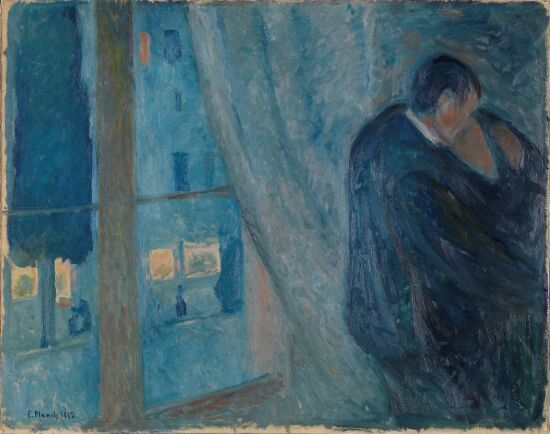 The KissEdvard Munch1892
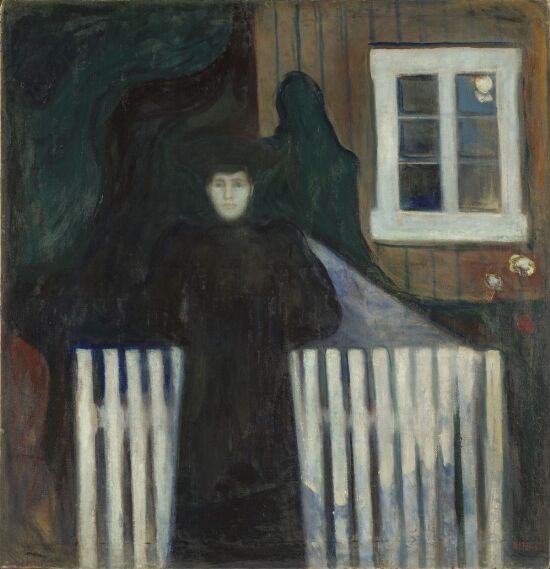 MoonlightEdvard Munch(1893)
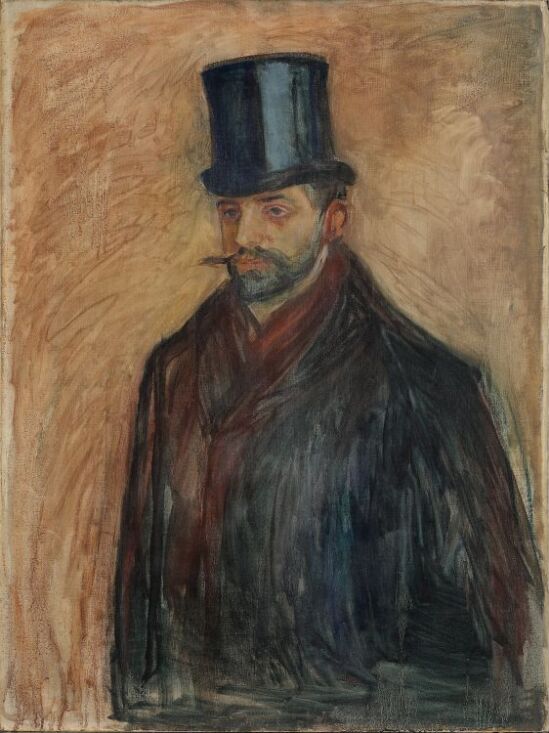 Julius Meier-GraefeEdvard MunchAntagelig 1894
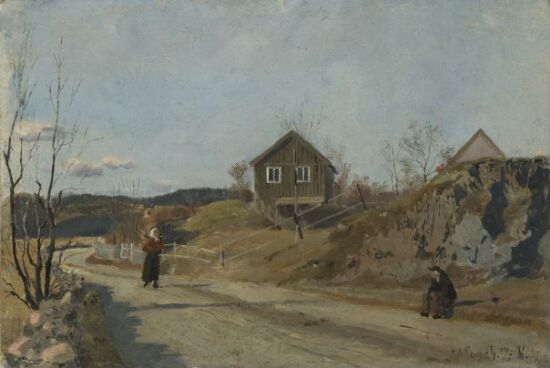 From Vestre AkerEdvard Munch1881
 MelancholyEdvard MunchAntagelig 1892
 Flowery Meadow at VeierlandEdvard Munch(1887)
 White NightEdvard MunchPåbegynt 1900, avsluttet 1901
 Rue LafayetteEdvard Munch1891
 Naked Woman in Front of a HouseEdvard Munch1883 eller 1884
 Self-PortraitEdvard Munch1905
 Inger Munch in BlackEdvard Munch1884
 Bathing ManEdvard Munch(1918)